
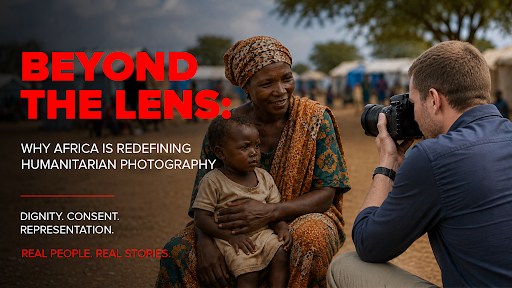
06 Aug Beyond the Lens: Why Africa Is Redefining Humanitarian Photography
For decades, humanitarian photography has been one of the most powerful tools for mobilizing global support. A single image has the ability to inspire donations, influence policy, document crises, and remind the world that behind every statistic is a human life.
Yet, alongside its power has come an increasingly important question:
At what point does documenting vulnerability become exploiting it?
Across Africa and the global humanitarian sector, this question is no longer confined to ethics committees and communications departments. It is beginning to influence national policy, donor expectations, and the way organizations tell stories.
A recent development in Burkina Faso – where authorities introduced restrictions on the use of exploitative images of humanitarian beneficiaries – has reignited an important conversation that extends far beyond one country. It signals a broader evolution in how dignity, consent, and representation are being understood in humanitarian communication.
For organizations, NGOs, photographers, documentary filmmakers, development agencies, and communication professionals, this is more than a policy change. It is a reminder that the future of storytelling belongs not to those who can capture the most emotional image, but to those who can tell the most respectful story.
The Era of “Poverty Sells”
For many years, humanitarian campaigns across the world relied heavily on emotionally charged imagery.
Children with visible signs of malnutrition.
Families standing beside destroyed homes.
Patients receiving emergency treatment.
Women waiting in long food distribution lines.
Communities affected by drought, conflict, floods, or disease.
The intention behind these images was often genuine. Organizations needed to demonstrate need, communicate urgency, and encourage international support.
In many cases, these photographs helped raise millions of dollars that funded life-saving interventions.
However, over time, concerns emerged.
Critics began asking whether people experiencing hardship were being portrayed as complete human beings – or merely as symbols of suffering.
Communities increasingly questioned why their most vulnerable moments were the images that reached international audiences while their resilience, innovation, culture, leadership, and daily lives remained invisible.
This gave rise to what many now describe as “poverty porn” – the practice of using images of extreme hardship primarily to provoke emotional reactions that encourage donations or publicity.
While the term is provocative, it reflects a serious ethical concern: reducing individuals to their suffering rather than recognizing their humanity.
A Shift Toward Dignity
The humanitarian sector has been evolving for years.
Major international organizations, including UN agencies, international NGOs, and development institutions, have strengthened internal guidelines around ethical photography.
These guidelines increasingly emphasize:
- informed and meaningful consent;
- respect for privacy;
- protection of children and vulnerable individuals;
- accurate representation;
- cultural sensitivity;
- avoiding stereotypes;
- presenting people with agency rather than portraying them solely as victims.
This represents a significant philosophical shift.
The question is no longer:
“How can we create the most emotional image?”
Instead, communicators are asking:
“How can we tell truthful stories while protecting the dignity of the people whose lives we document?”
That distinction changes everything.
Burkina Faso’s Recent Decision
Recent regulations introduced in Burkina Faso have attracted international attention because they go beyond internal organizational policy.
The measures place restrictions on the use of exploitative humanitarian imagery, particularly where beneficiaries are portrayed in degrading or humiliating ways or where their vulnerability is used for promotional or fundraising purposes.
Contrary to some headlines circulating online, this is not a blanket prohibition on humanitarian photography.
Organizations may still document programmes and development work.
What is being challenged is a style of communication that relies on portraying people primarily through the lens of desperation.
The regulation reflects a broader belief that receiving humanitarian assistance should never require sacrificing one’s dignity.
Why This Matters Beyond Burkina Faso
Whether or not other governments adopt similar regulations, the direction of travel is becoming increasingly clear.
Across Africa, conversations about ethical storytelling are intersecting with broader discussions around:
- digital rights;
- personal privacy;
- informed consent;
- child protection;
- data protection laws;
- community ownership of stories;
- decolonizing international development.
African communities are increasingly asking an important question:
Who owns our stories?
Historically, many stories about Africa were produced primarily for audiences outside Africa.
Images were often selected based on what generated sympathy overseas rather than what accurately reflected communities’ lived experiences.
Today, communities expect something different.
They expect partnership instead of extraction.
Collaboration instead of observation.
Respect instead of pity.
The Difference Between Documentation and Exploitation
Ethical storytelling does not mean avoiding difficult realities.
Conflicts still happen.
Displacement still occurs.
Climate change continues to affect millions.
Health emergencies remain part of humanitarian work.
These realities deserve documentation.
However, ethical documentation asks additional questions before pressing the shutter:
Has informed consent genuinely been obtained?
Does the individual understand how this image may be used years from now?
Would they be comfortable if their family, employer, or community saw this image?
Does the photograph preserve their dignity?
Does it reinforce harmful stereotypes?
Does it present context instead of reducing someone to a single moment of vulnerability?
Can the story be told just as effectively while protecting identity?
These questions are becoming essential professional standards rather than optional considerations.
Donors Are Also Changing
Ethical storytelling is no longer driven solely by communications teams.
Many institutional donors now expect organizations to demonstrate robust safeguarding and consent practices.
Increasingly, proposals include questions about:
- ethical media collection;
- safeguarding procedures;
- informed consent documentation;
- secure storage of visual assets;
- protection of children’s identities;
- responsible digital publishing.
The quality of an organization’s visual ethics is becoming part of its overall credibility.
Strong safeguarding practices are no longer separate from communications.
They are communications.
What This Means for NGOs
Organizations operating across Africa should view this shift as an opportunity rather than a restriction.
Communication strategies that prioritize dignity often produce more authentic and lasting engagement.
Instead of focusing exclusively on visible hardship, organizations can document:
community leadership;
local innovation;
women leading change;
youth entrepreneurship;
farmers adapting to climate change;
health workers improving outcomes;
teachers transforming education;
survivors rebuilding their lives;
local partners driving sustainable solutions.
These stories remain compelling.
In many cases, they are even more powerful because they communicate hope alongside reality.
The Role of Professional Storytellers
Photographers, filmmakers, journalists, and documentary producers occupy a unique position of trust.
Their work shapes public understanding.
It influences donor decisions.
It creates historical records.
It affects how entire communities are perceived.
Technical excellence alone is no longer enough.
Professional storytelling increasingly requires cultural intelligence, ethical judgement, and sensitivity to power dynamics.
Capturing beautiful images is only part of the responsibility.
Understanding when not to take a photograph is equally important.
A New Standard for African Storytelling
Africa is home to extraordinary stories of resilience, innovation, leadership, creativity, and transformation.
The continent’s future narrative should not be defined solely by crisis.
Nor should humanitarian communication ignore genuine need.
The challenge is to balance honesty with dignity.
To document reality without diminishing humanity.
To inspire support without exploiting vulnerability.
To tell stories with communities rather than merely about them.
This is not simply an evolution in communications.
It is an evolution in respect.
Spark Publicity’s Perspective
At Spark Publicity, we believe the future of humanitarian storytelling lies in ethical visual communication that places people before publicity.
Every photograph represents a person with rights, aspirations, relationships, and a story that extends far beyond a single frame.
Our approach is rooted in informed consent, cultural sensitivity, collaborative storytelling, and authentic representation. We believe the strongest stories are those that preserve dignity while communicating impact—stories that recognize beneficiaries not as passive recipients of aid, but as partners, leaders, innovators, and agents of change within their own communities.
As governments, donors, and organizations continue to raise expectations around ethical communications, visual storytelling must evolve alongside them.
The question is no longer whether dignity should guide humanitarian photography.
The question is how effectively we can build a communications culture where dignity is never compromised.
That future has already begun. The organizations that embrace it today will be the ones best positioned to earn trust, strengthen partnerships, and tell stories that truly honour the people they serve.